13 Ngatiawa and Waikanae Rivers and the Mangaone Valley
Access: The road-ends for the Waikanae and Ngatiawa Rivers can both be reached from Upper Hutt via the Akatarawa Road, or more directly from Waikanae. These roads have some narrow reaches that require care. Trampers planning to use the Akatarawa Road from the Hutt Valley for access to this area are advised to consult the Kapiti Coast District Council road status page. This is also accessible as a quick link at the bottom of their homepage.
Waikanae River road-end: Along Akatarawa Road 4.7 km from Waikanae, Ngatiawa Rd branches L and 700 metres along this, Mangaone South Rd branches L for 5.3 km to the carpark at its end. From this carpark the Mangaone Walkway heads N, crossing the east branch of the Waikanae River.
Ngatiawa River road-end: This is 4 km beyond the Mangaone South Rd turn-off. Trail markers will be seen through the left-most gate marking the route that leads to Kapakapanui. This crosses private land which should be treated with respect. Park your car well clear of the gates.
Overview: These two minor valley systems, headwaters of the Waikanae River, contain the popular Mangaone Walkway, and tracks to Kapakapanui, Renata and Waiotauru. The infrequently visited Waikanae River branches contain considerable areas of lowland forest, much of it still in original condition. [revised November 2017]
13.1 Mangaone Walkway
This Walkway has a carpark at each end. Walking south to north is the better direction, with the first half of the journey through pleasant regenerating bush, with some fine rimu rickers beside the track and glimpses of mature forest on the skyline. There are many private grassy or flat areas for picnics and recreation. On some of the sharper curves of the track, radial grooves on the track edge indicate the position of the sleepers of the old bush tramline. In what is now the Kaitawa Scenic Reserve, beside the southern part of the Walkway, there are a number of old logging roads. These disused roads are neither maintained nor marked, but visitors are free to explore them at will. The second half of the track at the N end is over formed road. About 90 minutes between carparks.
Northwards: From the Mangaone Walkway southern carpark, the track crosses a swing-bridge and rejoins the old road. Less than 2 minutes further on, the foot trail drops into bush on the L. The track is well defined and in a few minutes crosses a bridge over the Waikanae River north branch. From here the old tramline stays on the TR of the stream until open grassland is reached. The route then soon crosses the stream to the farm road on the TL, which it follows to the northern end – 40 minutes or so away.
Southwards: Access is from Te Horo, 8km N of Waikanae, where Hautere Cross Rd leads R across the railway towards Ōtaki Forks. Mangaone North Rd branches off after 3.2 km, and leads in 4.1 km to the carpark at the N end of the Mangaone Walkway. The narrow gravel road needs care, and this road-end may be less secure for cars than the southern one.
Mangaone Walkway from the N is a formed road till almost halfway. For the first 20 minutes it climbs steadily to a saddle, then drops gently through pine forest and regenerating bush for another 20 minutes. Where the road ends at a private gate, the foot track begins on the L. The route now stays on the TR almost to the Waikanae end. Five minutes or so over grass brings a small gate and the start of the Waikawa Scenic Reserve, through which the Walkway leads. Apart from a short climb around a slip, the track is well benched. Forty minutes from the small gate to the road-end carpark. [revised November 2017]
13.2 Pukeatua from Mangaone South Road
This is a section of the Te Araroa Trail.
From the carpark, follow the Mangaone Walkway to a swingbridge and rejoin the old road. Less than 2 minutes further on, turn R through a gate; the old logging road leads in 15 minutes to a forks. Between the two branches of the stream, a rough logging road climbs steeply for 10 minutes before easing for another 10 minutes. From this point, a track alternately climbs and flattens through bush to reach the cleared top of Pukeatua, 2 to 2½ hours from the carpark.
Down: the track is well marked, but care is needed where dry leaf litter obscures the pad. On reaching the forks, go 50m up the TR branch to find the old logging road. [October 2017]
13.3 Kapakapanui from Mangaone South Road
Owing to changes in land ownership, the direct route through the pine plantation and over .374 is no longer allowed. However, there is fair access from the track to Pukeatua (see 13.2). Some 250m on from the point where, just above the 700m contour, the track flattens and turns S, watch for the main ridge joining from the R The route along this ridge to .890, above Kapakapanui Hut, is not clearly marked and is prone to windfall. From .890, the trail soon emerges from the forest and continues up past the repeater station on .1094 to the Kapakapanui summit beacon less than an hour away. [revised October 2017]
13.4 Kapakapanui from Ngatiawa Road end
From the left-hand gate at the Ngatiawa Road end, trail markers lead down and across paddocks to the Ngatiawa River. The Ngatiawa Forks are 12 minutes, and 4 crossings, upstream. The last crossing leads to the toe of the spur between the forks, and the Langer memorial tablet. Two routes go to Kapakapanui from here. One climbs the SE spur between the forks directly to Kapakapanui. The other climbs the spur NE of the forks, then swings past Kapakapanui Hut and on to the summit. Both tracks are well padded and well marked.
Up by the SE spur. From the forks, 2½ hours of steep climbing gains the summit of Kapakapanui. Twenty-five metres before the top, the trail from the Ngatiawa-Waiotauru Saddle joins. The summit is marked by a large trig beacon.
Panoramic views extend from the islands off the coast, past the Southern Crossing in the E, to the conspicuous pyramid of Arete in the distant NE. From this angle, its aretes proclaim the name origin.
From the summit, the anti-clockwise circuit can be completed by following the trail N. It soon passes the transmitter station on .1094 to veer NW and drop to the bush. Kapakapanui Hut is reached in less than an hour from the summit. From the hut the track continues NW to .755 in 15 minutes. The trail then heads W, soon bearing SW, and leaves the gentle uplands 15 minutes from .755, to drop to the Ngatiawa Forks, 90 minutes from the hut.
Up by the NE spur. From the forks, the route continues up the TR branch of the stream, with several crossings, for 6 minutes before zig-zagging up on the L. After about an hour, the track becomes less steep, and a further hour or so brings the hut. Eight or ten minutes above the hut, on a small knob, the indistinct Henderson route joins from the Pukeatua track. After a further 25 minutes, the track emerges onto the open tops, passing the transmitter station on .1094 before arriving at the large trig beacon on the summit, about an hour from the hut. [revised October 2018]
Kapakapanui Hut
Kapakapanui Hut
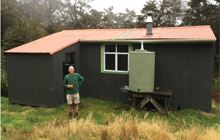
Kapakapanui Hut is a Standard hut, located at -40.917, 175.155. There are 6 bunks with heating, mattresses, toilets - non-flush, water from tap - not treated, boil before use, and water supply. Bookings are not required, usage is first come, first served.Kapakapanui Hut alert
Predator control Tararua Forest Park
DOC and OSPRI distributed toxic cereal bait pellets by helicopter near this area on 11 and 23 March and 19 May 2026.
A caution period is in place for approximately 8 months. Visitors are advised not to take dogs into the area until the caution period has ended. 1080 is deadly to dogs. How to keep dogs safe around 1080.
First published on 3 March 2026. Last reviewed on 21 May 2026.
DOC and OSPRI distributed toxic cereal bait pellets by helicopter near this area on 11 and 23 March and 19 May 2026.
A caution period is in place for approximately 8 months. Visitors are advised not to take dogs into the area until the caution period has ended. 1080 is deadly to dogs. How to keep dogs safe around 1080.
First published on 3 March 2026. Last reviewed on 21 May 2026.
13.5 Odlins Road/Waiotauru Road: Maymorn Junction from Akatarawa Saddle
This road is not signposted, and is quite variable in its state of repair, with a large slip below the road 9km in; it is barely suitable even for 4WD vehicles. Tramping time to Maymorn Junction is 2½ hours.
From the highway, the 4WD track climbs and sidles east and north to just under .561, passing half-a-dozen side tracks on the way. Noteably there are white hydrangeas planted at the roadside every so often. The 4WD road now drops to the east to climb and wind its way south above Ngatiawa River toward Kakanui. From there it winds and sidles to the saddle known as Maymorn Junction, just below .822 (the true Maymorn Junction is 500 metres to the east). At the saddle the 4WD track to Waiotauru Hut is straight ahead (see 14.25), the track to Renata Hut is up on the bank to the right, and the track to Kapakapanui climbs off to the L a bit further on, at the N end of the saddle. [revised March 2019]
13.6 Kapakapanui from Maymorn Junction
In the first hour from the Maymorn Junction (see 13.5), the track climbs gently, continues along a ridge, and drops finally to a major saddle. From here the trail climbs steeply towards Kapakapanui another 75 minutes away.
The last part of the climb is over alpine wetland meadow resulting from the burn in 1903. The recovery time to full forest may be another 1000 years. [revised March 2019]
13.7 Renata Hut from Maymorn Junction
From the Maymorn Junction saddle, the track climbs a little over .822 to the actual Maymorn Junction, then drops steadily to join the trail from the Frances Stream. Renata Hut should be reached in 30-45 minutes from the 4WD road.
Renata Hut
Renata Hut
Renata Hut is a Bivvy or Basic hut, located at -40.968, 175.173. There are 6 bunks with heating, toilets - non-flush, water from tap - not treated, boil before use, and water supply. Bookings are not required, usage is first come, first served.Renata Hut alert
Predator control for Southern Tararuas
DOC and OSPRI distributed toxic cereal bait pellets by helicopter in this area on 11 and 23 March 2026.
A caution period is in place for approximately 8 months. Visitors are advised not to take dogs into the area until the caution period has ended. 1080 is deadly to dogs. How to keep dogs safe around 1080.
First published on 3 March 2026. Last reviewed on 21 May 2026.
DOC and OSPRI distributed toxic cereal bait pellets by helicopter in this area on 11 and 23 March 2026.
A caution period is in place for approximately 8 months. Visitors are advised not to take dogs into the area until the caution period has ended. 1080 is deadly to dogs. How to keep dogs safe around 1080.
First published on 3 March 2026. Last reviewed on 21 May 2026.
Ungulate control for parts of Tararua Forest Park
Ungulate (goats, deer, pigs) control work will take place from January to July 2026. The operation will include both aerial shooting and ground hunting with indicator dogs, thermal drone assistance as well as aerial surveillance and trail cameras for monitoring. The operation is shown on the map in the solid pink and solid yellow buffer zones.
First published on 22 January 2026. Last reviewed on 5 May 2026.
Ungulate (goats, deer, pigs) control work will take place from January to July 2026. The operation will include both aerial shooting and ground hunting with indicator dogs, thermal drone assistance as well as aerial surveillance and trail cameras for monitoring. The operation is shown on the map in the solid pink and solid yellow buffer zones.